Hanging a Chandelier in a Two-Storey Foyer or Stairwell, Done Safely
High ceilings, heavy fixtures, and a long drop to the floor make this a job to plan, not improvise.
October 13, 2026 · 4 min read
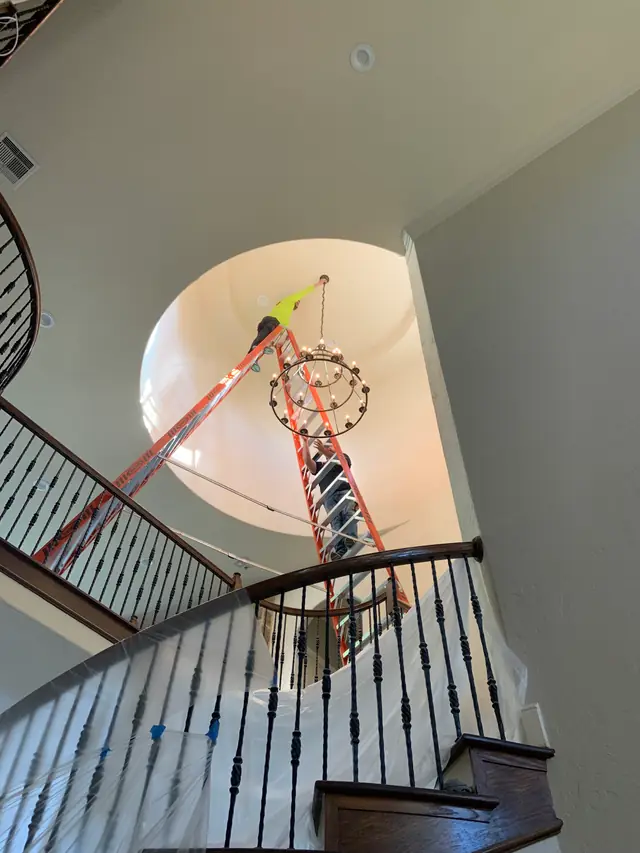
Why a tall foyer is a different job
Hanging a light over a dining table means a six-foot stepladder and an afternoon. Hanging one in a two-storey foyer or over a curved staircase means reaching a ceiling that might be eighteen feet up, often above stairs or a drop-off, with a fixture that can weigh as much as a person's leg. The wiring is the same idea. Everything around it is harder.
Some of the photos from G4 Electric's own jobs show exactly this: a tech on a tall extension ladder hanging an iron chandelier in a curved stairwell, another with a candle chandelier over a two-storey living room. Both look calm in the pictures. The calm comes from planning.
Start with weight and support
Before anything goes up, the question is what's holding it. A standard ceiling box is designed for light fixtures, and many chandeliers are heavier than that box was built to carry. A heavy fixture needs a box or bracket rated for its weight and fastened to framing, not just screwed to drywall. If the house was built without blocking in that spot, the ceiling may need to be opened so a proper support can go in.
The fixture's manual lists its weight. Have that number ready, along with the overall height and the length of chain or cable that comes with it. In a tall space, a chandelier that looks right in a showroom can look tiny hanging at the top of a big void. Scale matters as much as the wiring.
Power off, and proof that it's off
The first step on any light fixture is turning off the breaker, and the second is confirming the circuit is actually dead with a tester. Light switches and breakers get mislabeled all the time, and in a foyer the circuit might share a line with other lights or outlets you didn't expect. Testing takes thirty seconds. Skipping it is how people get hurt on a ladder when a shock makes them jump.
Getting the fixture up there
Height is where the risk is. A tall extension ladder needs level footing, and on a staircase that means a ladder leveler or a stable platform rather than a guess. Two people make the job safer, one working at the top and one controlling the fixture's weight from below. The installer assembles the chandelier in sections when the design allows, hangs the canopy and the support first, then lifts and connects the body.
- Level, stable footing for the ladder or platform, especially on stairs
- A second person to steady the ladder and handle the fixture
- Support hardware rated for the chandelier's weight
- Wire connections made and checked before the fixture takes its final weight
- Bulbs installed last, after the fixture is secure
Height, drop, and how it looks
A common rule of thumb is to keep the bottom of a chandelier high enough that nobody walks into it, usually at least seven feet above a walking path. In an open foyer, you can go higher. The better test is how it reads from the front door and from the top of the stairs. A fixture that hangs too high looks lost, and one that hangs too low crowds the room. Ask for a trial hang at the planned height before the chain is cut.
Think about changing the bulbs
Every bulb in that chandelier will burn out someday, and you will not want to haul a tall ladder up your staircase to replace it. LED lamps with long ratings cut down how often you'll need to. A motorized or manual lift system can lower the fixture to hand height for cleaning and bulb changes. It's worth asking about before the fixture goes up, because the lift is much easier to install at the beginning.
A dimmer is also worth planning for. A foyer chandelier that's bright at noon is harsh at night, and a dimmer matched to the lamps gives you control. Check that the dimmer is rated for the type of bulb you use, since LED lamps and dimmers have to be compatible to avoid flicker.
Why not do it yourself
Plenty of people can wire a light fixture. A tall stairwell is about the ladder, the weight overhead, and the ceiling support, not the wiring. A fall from that height is serious, and a fixture that comes down can hurt someone below. Calling a licensed electrician with the right equipment and a second set of hands is the safe choice.
Ready to hang yours
If you have a chandelier waiting in a box, call G4 Electric at (936) 264-1387 and tell us the fixture's weight and the ceiling height. Photos of the space help, and you can send them to info@g4electric.net. We hang fixtures in homes around Conroe, Woodforest, The Woodlands, and the rest of Montgomery County.
G4 Electric LLC, (936) 264-1387
Call (936) 264-1387More articles
Breakers Tripping in a Newer House? When a Dedicated Circuit Is the Fix
A new house can still have circuits that don't match how you actually live, and a dedicated line is often the cleanest answer.
Wiring a Metal Shop or Barn: What to Plan Before the Electrician Shows Up
A shop is easy to wire well and expensive to fix later, so a little planning on the front end pays off.