Standby Generators for Montgomery County Storms: What an Install Involves
A standby generator is more than a box on a pad, and knowing the pieces helps you make a better decision.
October 13, 2026 · 4 min read
Standby versus portable
A portable generator sits in the garage until the lights go out. Then you drag it outside, run cords, and refuel it every few hours. A standby generator sits on a pad outside the house, connects to a fuel supply, and starts itself when the power drops. For people who live with storm outages around Conroe and The Woodlands, that's the difference between a night of extension cords and a house that just keeps running.
G4 Electric installs Generac standby units, and one Google reviewer, Jeremy Stout, summed up the crew's range this way: “Also does generators as well.” The generator itself is half the picture. The electrical work around it is what makes it safe and usable.
The transfer switch is the important part
A transfer switch is what lets your house run on generator power safely. When utility power fails, the switch disconnects your house from the grid and connects it to the generator. That separation matters. Without it, a generator can push power back out onto the lines, which is a serious danger to utility workers and anyone nearby. It also keeps the generator from being overloaded by trying to feed the whole neighborhood.
Most standby systems use an automatic transfer switch. It senses the outage, signals the generator to start, waits for steady output, and then moves the house over. When utility power returns, it switches back and lets the generator cool down and shut off. You don't do anything.
Sizing: what do you want running?
Generators are sized to a load, so the first step is deciding what must keep running. Some homes want everything. Others only need the essentials. A big air conditioner or an electric range pulls far more than a refrigerator, and a well pump or an electric water heater adds up fast. Some installations use load management, which sheds the largest loads automatically so a smaller generator can handle the rest.
Before the site visit, it helps to write down:
- The size of your main panel and what is labeled on it
- How many air conditioning systems you have
- Whether you have a well pump or sump pump
- Gas or electric for your range, dryer, and water heater
- Anything medical or business related that cannot lose power
Fuel and placement
A standby generator runs on natural gas or propane. If you're on natural gas, the line to the generator is tied into your gas service. With propane, you have a tank on site. Gas piping is a separate trade from electrical work, and a licensed gas fitter or plumber typically handles it, so ask how the job will be coordinated when you're getting a plan together.
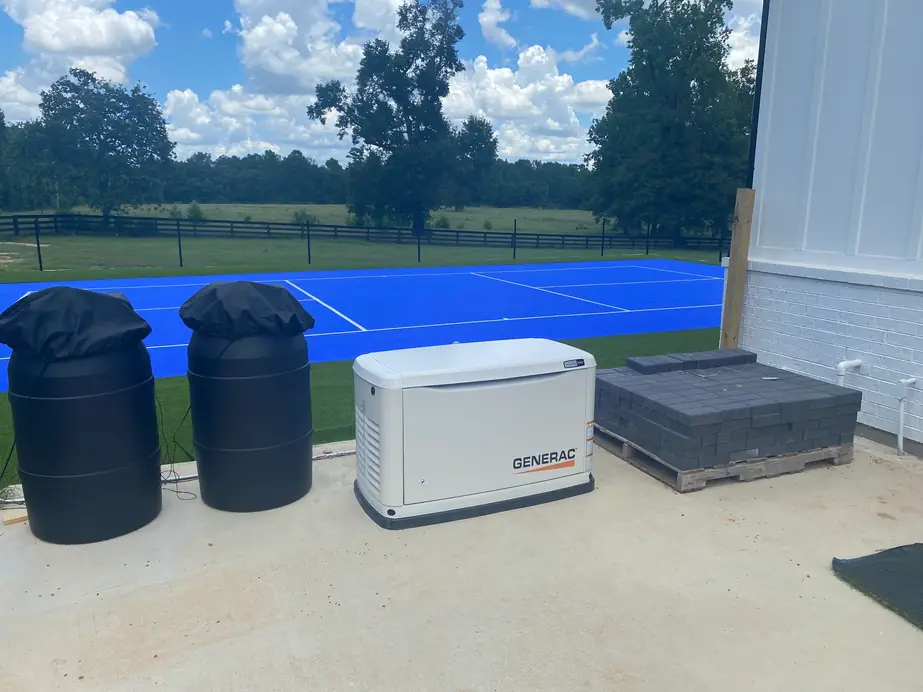
Placement is a mix of rules and common sense. Generators need clearance from the house, windows, vents, and property lines, and your city or HOA may have its own requirements for distance, screening, and noise. A pad with good drainage matters in this part of Texas, where heavy rain is common. Ask about setbacks and permits for your address before you pick a spot. The photo at the top of this page shows a generator on a pad beside a sport court with open pasture behind it, a good example of a spot with plenty of room.
What the electrical work includes
The electrician sets the transfer switch near the main panel, runs conduit and conductors between the switch, the panel, and the generator, installs the control wiring that tells the generator when to start, and connects everything with correct grounding and bonding. The circuits you've chosen to back up get moved to a separate panel or fed through the switch. Then the system is tested under load before anyone calls it done.
- Transfer switch installed and wired to the main service
- Conduit and conductors sized for the generator output
- Control wiring between generator and switch
- Grounding and bonding checked
- Startup and a load test with the house on generator power
Maintenance and what comes after
A standby generator runs a short self-test on a schedule, usually weekly, so it stays ready. It still needs service on a regular basis, like any engine: oil, filters, spark plugs, and a battery check. Skipping it is the most common reason a generator fails when it's needed. Keep the area around it clear of mulch, leaves, and stored items, and keep the intake and exhaust free.
If your area loses power, a generator is also a reason to know your panel. Label it, find the main breaker, and make sure everyone in the house knows what stays on and what doesn't.
Start the conversation
If you're weighing a standby generator for your Montgomery County home, call (936) 264-1387 and tell us how big the house is and what you want to keep running. We'll walk through the options with you. You can also email info@g4electric.net with photos of your panel and the spot where you'd like the unit to go. If the power's already out, the phone line is answered around the clock.
G4 Electric LLC, (936) 264-1387
Call (936) 264-1387More articles
Breakers Tripping in a Newer House? When a Dedicated Circuit Is the Fix
A new house can still have circuits that don't match how you actually live, and a dedicated line is often the cleanest answer.
Wiring a Metal Shop or Barn: What to Plan Before the Electrician Shows Up
A shop is easy to wire well and expensive to fix later, so a little planning on the front end pays off.